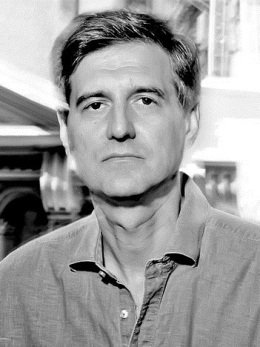
Raickovich’s music has been performed in numerous venues in Europe and the USA, including the Warsaw Autumn Festival, Zagreb Music Biennale, Europhonia Radio Festival, Carnegie Hall, La MaMa Etc. and Miller Theater in New York, and the Kennedy Center in Washington, D.C. Among the performers of Raickovich’s music are the Moscow Symphony Orchestra (M. Raickovich, conductor), Honolulu Symphony Orchestra (Donald Johanos, conductor), Beach Cities Symphony in Los Angeles (Barry Brisk, conductor), RTS (Belgrade Radio) Symphony Orchestra (David Porcelijn, Milen Nachev, Bojan Sudjic and Milos Raickovich, conductors), Ensemble Divertimento (Milan), Margaret Leng Tan, Dorothy Lawson, Reiko Watanabe, Gloria Cheng, Jed Distler, Beth Levin, Christopher Oldfather, Tatjana Rankovich, Dusan Bogdanovic, and Nada Kolundzija, among others.
Milos Raickovich studied composition with Vasilije Mokranjac, Olivier Messiaen and David Del Tredici; and conducting with Borislav Pascan, Pierre Dervaux, Barry Brisk and Herbert Blomstedt. He holds a Ph.D. in composition from The City University of New York, and has taught at several universities in the U.S. and Japan. His choral work "Parastos" is published by Boosey & Hawkes. Milos Raickovich has also written music for film, including the score for Evans Chan’s "The Map of Sex and Love," which has been nominated for the best original film score at the Taipei Golden Horse Film Festival in 2001. A member of ASCAP, Milos Raickovich has received three CAP awards from the American Music Center.
Milos Raickovich’s early compositions, written in the late 1970s, can best be described as minimalist, ascetic and meditative. Since 1979, his music has evolved into a style that combines Minimalism with Classical forms, a style that he calls “New Classicism.” The Los Angeles Times critic Mark Swed describes Raickovich’s New Classicism as "...neither ironic nor naive but, instead, a unique postmodern response to both Minimalism and multiculturalism. It is surely possible to hear Schubert, Haydn or Rossini in Raickovich's "New Classicism"; but under Schubert, Haydn or Rossini lie Eastern European folk music, Minimalism, Messiaen, and, deeper still the Pacific Rim and its cultures. All are part of Raickovich's remarkable musical roots, but they operate in the background, nested like the windows on a computer screen.” Raickovich has composed solo, chamber, orchestral, vocal and choral works, as well as music for film, dance and theatre. Since 1999, Milos Raickovich has written a number of works with antiwar message. Critic Steve Smith described Raickovich’s antiwar pieces in Time Out New York: “Some of the works are wistful and poignant, while others are jarring and volatile; all are inventive, provocative and timely.”
Milos Raickovich’s orchestral music is released on Mode Records, on the CD NEW CLASSICISM,featuring pianist Margaret Leng Tan and the Moscow Symphony Orchestra conducted by the composer. Critic Raymond Tuttle writes: "This is one of the strangest discs that I've heard all year. That's a compliment. Strongly recommended to both the informed and the unwary." (Fanfare)
Raickovich’s CD B-A-G-D-A-D (Albany Records), features a collection of antiwar pieces. Critic Jeff Simon writes: “In its decidedly unassuming and unremarked way, this disc may be a major milestone of classical music in our era. Here is the first truly haunting music to come from resistance to the war… Seldom does politically inspired music have the power and beauty of this.” (The Buffalo News)
Milos Raickovich’s CD FAR AWAY (Albany Records) was released in 2010: "Milos Raickovich’s program covers music from as early in his career as 1979 and as late as 2006. The earliest piece, Flying Trio, begins with the yearning and flowing ‘Lonely Rider’. Pushed along by the piano’s earnest efforts, the violin and cello play simple, classical melodies reminiscent of Schubert with moments of Beethoven. ‘Anger and Love’ is passionate and tempestuous. The violin bows malevolently while the cello reaches high and low before a quiet lullaby appears. B-A-G-D-A-D, an antiwar piece written in its original version in 2002, is the only piece on the program that uses a diatonic scale. Raickovich spreads a simple motive through his piece with care before erupting into rapturous orchestra hits that become displaced. A loud section is expected in an antiwar piece, but composers often get carried away. Raickovich’s execution is controlled, mournful, and no more bombastic than it need be. The solo sections for flute, oboe, and harp are rustic and pleading. El Contorno Variations is a work for cello and piano based on a five-note scale and written for Evan Chan’s film The Map of Sex and Love. Raickovich includes East Asian motives and techniques to approximate traditional Asian instruments. The seven variations of the dark, bleak, theme offer lightly prepared piano, plucked strings, slides, and echoes. Winter Waltz has the approachable nature of one his composition teachers, David Del Tredici, and the sensibilities of Tchaikovsky. Composed with only five tones, the piece swirls as its traditional waltz motif is passed to different instruments." (American Record Guide)