As the son of Stevan Udicki, notary, and Anica Udicki Pavlovich, he was born on January 14, 1911, in Velika Kikinda, Banat. He finished the public and secondary school at Velika Kikinda and Timisoara (Romania), the Seminary in Sremski Karlovci (Yugoslavia) in 1930, when he entered the University of Belgrade and finished the Faculty of Orthodox Theology in June 1934.
After the military service in the Red Cross company in Bitola (Yugoslavia) in 1934/35, he became a teacher of the Seminary and gymnasium in Bitola on March 15, 1935. On November 14, he was ordained a priest, on special duty at the monastery church of St. John the Baptist in Bitola till 1938, when passed the examination of a Master degree.
He took monastic vows in the Monastery of Hilandar in 1936.
In September 1938 he went to the U.S.A., to Libertyville, Illinois, taking up there the job of a secretary of the Orthodox Diocese and later on duty of a priest at the Holy Trinity Church at Butte, Montana. In order to complete the studies necessary for getting the PhD degree, he went in 1939 to Athens (Greece), but soon returned to Yugoslavia because of the war between Greece and Italy. Having transferred studies to the University of Belgrade he passed the examination on June 11, 1940. Working on preparation of the dissertation he went to Petrovgrad, Banat (Yugoslavia), where he remained till 1945. During the wartime between Yugoslavia and Germany, he was just a manual worker, and later in 1943 he became again a teacher in Gymnasium and helped at the Church in Petrovgrad. In June 1945 he was forced by communists to leave because of his faith.
Persecuted, he had to change his place of his residence. In June 1945, he went to Monastery “Vojlovica” near Pancevo (Serbia). Meanwhile the monastery was occupied by the government’s “Red education center” for children and remained therefore without possibilities of supporting many clergymen. With others he was compelled to make a living as a factorial laborer in a mill, holding the Sunday-service in the monastery church. After passing the course and examination of bookkeeping and statistics he succeeded to the post of a bookkeeper at the “Pančevački parni mlin” ltd”, Pančevo. In 1947, as in accordance with the new reorganization, the mill in Pančevo was taken by the state completely. He went to Rijeka on duty of a bookkeeper statistician at the factory Antonic Vezzil, Fuime. Soon he escaped to Italy on the August 26, 1949.
After the war, he served in various parishes in the United States. In 1957, he was awarded the rank of Archimandrite by the Holy Synod on the recommendation of Bishop Dionisije. When elected Bishop, he was a parish priest in Youngwood, Pennsylvania.
Since the West was distant from the See of the Diocese it was somehow neglected. It took a little while to organize the parishes and put church life in a certain spiritual perspective. The Diocese was small in size, less than a half the size of the Eastern and Midwestern Dioceses. That region was governed more by the Bishop’s deputies than by the Bishop himself. Now Bishop Grigorije had his hands full of work to be done. Due to its financial strength the St. Steven’s Parish in Alhambra supported the Diocese and it was able to function and carry out its work. The St. Steven parish provided the facilities for a Diocesan office and extended office help.
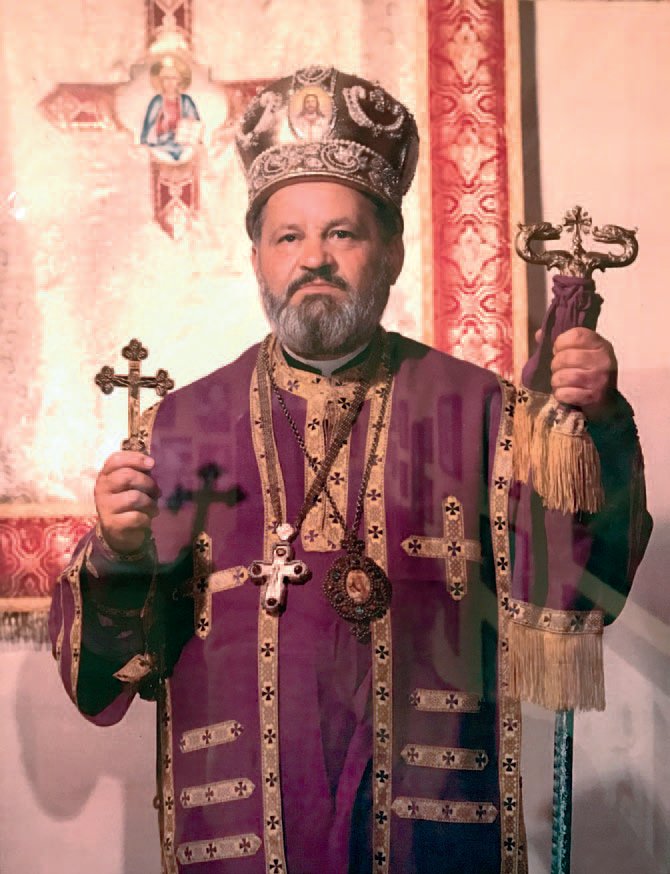
Bishop Grigorije left behind a beautiful legacy, and was deeply missed by everyone who had the privilege of knowing him. Bishop Grigorije was not only a distinguished hierarch, but a prominent scholar and theologian. His love for the Church and serving the Lord was the focus of his entire life, and he was always eager to share his knowledge with others to bring them closer to the fullness of Christ.
Beyond his intellectuality, Bishop Grigorije was truly a hierarch of the Lord. Priests were thankful for his demeanor while serving and his tolerance level for minor “glitches”. His kind and silent guidance to the priests and other servers enabled them to serve and experience the Liturgy to the fullest without stress or tension.
In the person of Bishop Grigorije, people were able to see what is the nature of hierarchy for a bishop. It is not so much governance, rule, or authority, the usual and daily exercises of our ecclesiastical leaders. It is the recognition of his place in the divine order and his willful, intelligent, faith-filled exercise of his symbolical role and function.
Bishop Grigorije fell asleep in the Lord in 1985. He was interred at the Serbian Cemetery in Los Angeles, CA.