A great man is one who collects knowledge the way a bee collects honey and uses it to help people overcome the difficulties they endure - hunger, ignorance and disease!
- Nikola Tesla

Remember, remember always, that all of us, and you and I especially, are descended from immigrants and revolutionists.
- Franklin Roosevelt

While their territory has been devastated and their homes despoiled, the spirit of the Serbian people has not been broken.
- Woodrow Wilson

Communique from the Holy Assembly of Bishops of the Serbian Orthodox Church, from May 17, 2012

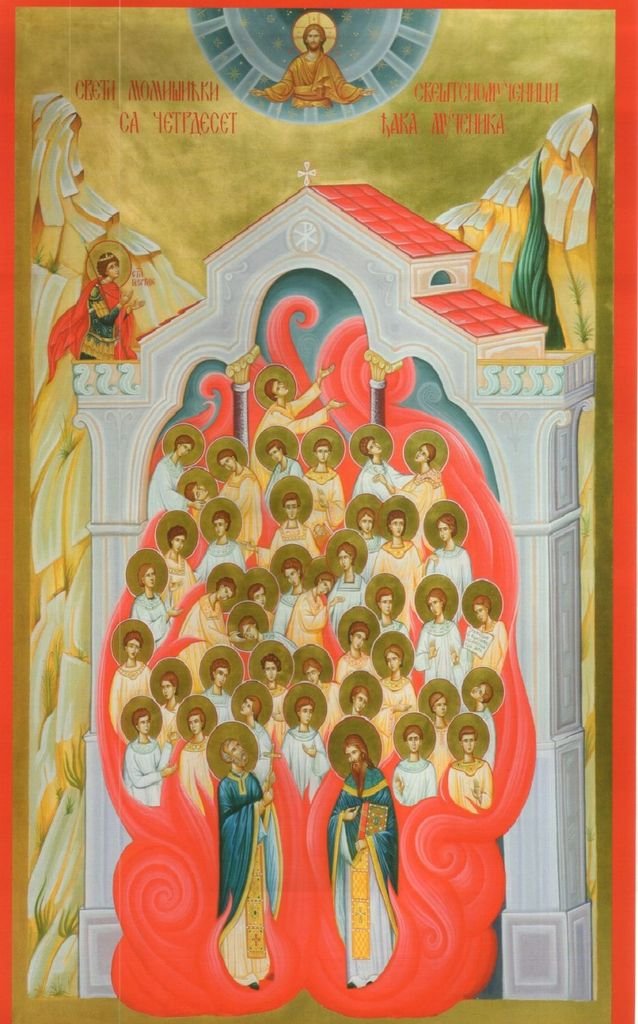
The Holy Assembly of Bishops of the Serbian Orthodox Church, during today's session rendered the decision to enter two priest martyrs and forty students-martyrs of Momisici into the Diptych of Saints and that their celebration (formal declaration of sainthood; canonization) be at the Holy Hierarchical Divine Liturgy at the St. Sava Memorial-Church on Vracar on Saturday, May 19, 2012, led by His Holiness Patriarch Irinej of Serbia at which their long and prayerful respect among the faithful of the Serbian Orthodox Church will be confirmed.

.

History of the Martyrs of Momisici

Two priests, serving as religious education teachers, and their forty students, children from the parish mostly from the brotherhood of Popovic were burned alive in 1688 at the St. George Church in the modern day Podgorica suburb of Momisici, at the hand of the Sulejman-Pasha army of Skadar, as a sign of retaliation which the Osmanlija Turks suffered from the hill tribes the previous months, particularly from Kucha.

Their relics were gathered and buried beneath the holy altar table of the St. George Church. During the entire time of Turkish rule, the relics remained in this church until 1936 when, with great honor and the litiya-procession of the people the relics were transferred to the renovated St. George Church in Momisici and placed beneath the holy altar table there. In 2006 the relics were taken out for the faithful to venerate on the feastday of the Holy 40 Martyrs of Sebaste, known commonly among the people as Holy Youths Day, after which Metropolitan Amphilohije, together with the clergy, washed them with wine and anointed them with rose oil according to the ancient Orthodox custom. Since then they can be found in a reliquary on the left hand side of the iconostasis of the Momisici church of St. George, which, since then, has also been dedicated to their holy memory. In commemoration of the last finding of their relics, for some years now in the Metropolitanate of Montenegro and the Coastlands their liturgical commemoration is celebrated on the feast of the Holy Martyrs of Sebaste.

SA


People Directory

Dolores Božović

Dolores Bozovic received her PhD in Physics in 2001, from Harvard University, on electron transport in carbon nanotubes. She then completed postdoctoral training at Rockefeller University, from 2001-2005, in a Sensory Neuroscience laboratory. From 2005 to the present, she was Assistant and then Associate Professor at the Department of Physics and Astronomy and the California NanoSystems Institute, at University of California Los Angeles.

.

Read more ...

Publishing

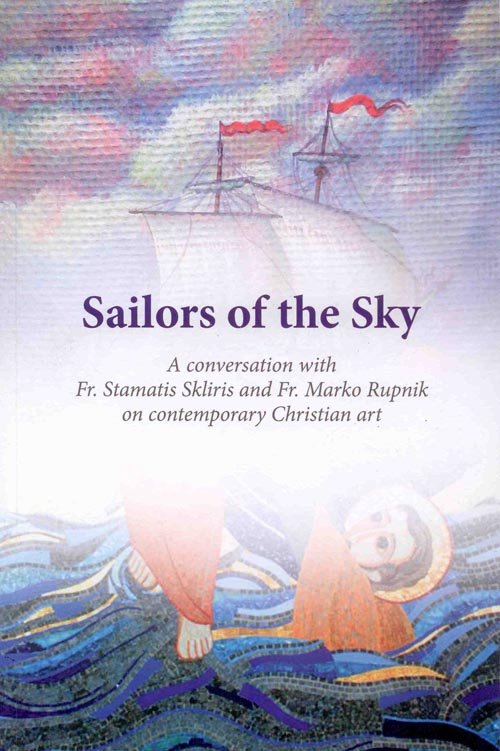
Sailors of the Sky

A conversation with Fr. Stamatis Skliris and Fr. Marko Rupnik on contemporary Christian art

In these timely conversations led by Fr. Radovan Bigovic, many issues are introduced that enable the contemporary reader to deepen and expand his or her understanding of the role of art in the life of the Church. Here we find answers to questions on the crisis of contemporary ecclesiastical art in West and East; the impact of Impressionism, Expressionism, Cubism, Surrealism and Abstract painting on contemporary ecclesiastical painting; and a consideration of the main distrinction between iconography and secular painting. The dialogue, while resolving some doubts about the difference between iconography, religious painting, and painting in general, reconciles the requirement to obey inconographic canons with the freedom essential to artistic creativity, demonstrating that obedience to the canons is not a threat to the vitatlity of iconography. Both artists illumine the role of prayer and ascetisicm in the art of iconography. They also mention curcial differences between iconography in the Orthodox Church and in Roman Catholicism. How important thse distinctions are when exploring the relationship between contemporary theology and art! In a time when postmodern "metaphysics' revitalizes every concept, these masters still believe that, to some extent, Post-Modernism adds to the revitatiztion of Christian art, stimulating questions about "artistic inspiration" and the essential asethetic categories of Christian painting. Their exceptionally wide, yet nonetheless deep, expertise assists their not-so-everday connections between theology, ar, and modern issues concerning society: "society" taken in its broader meaning as "civilization." Finally, the entire artistic project of Stamatis and Rupnik has important ecumenical implications that aswer a genuine longing for unity in the Christian word.

The text of this 94-page soft-bound book has been translated from the Serbian by Ivana Jakovljevic, Fr. Gregory Edwards, and Andrijana Krstic. Published by Sebastian Press, Western American Diocese of the Serbian Orthodox Church, Contemporary Christian Thought Series, number 7, First Edition, ISBN: 978-0-9719505-8-0